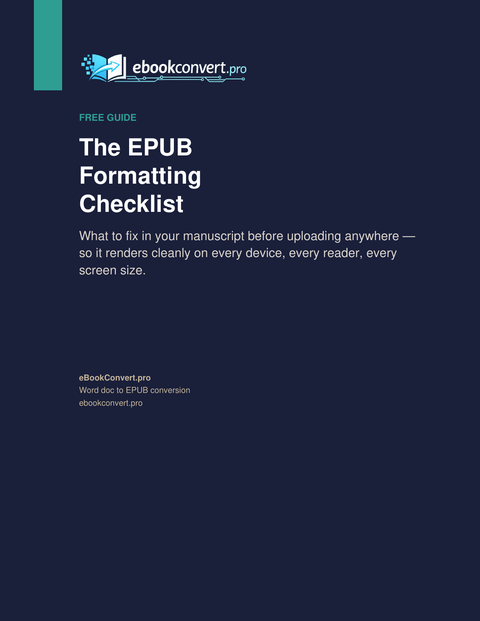
If you want your ebook to look polished after DOCX to EPUB conversion, the cover matters more than many first-time authors expect. A good cover does more than decorate the file: it helps readers recognize the book, improves the first impression in stores or downloads, and reduces the chance of awkward layout issues once the ebook is generated.
This guide walks through how to add a professional ebook cover that converts cleanly into EPUB and PDF. Whether you are self-publishing a novel, sending a report to clients, or preparing a branded lead magnet, the same basics apply: the cover should be readable, properly sized, and saved in a format that works well across devices.
How to add a professional ebook cover that converts cleanly
Before you upload anything, decide what role the cover is supposed to play. For retail-style ebooks, the cover needs to attract attention at thumbnail size. For business ebooks, the cover should look credible, match your brand, and avoid clutter. In both cases, the technical side matters just as much as the design.
A cover can look great on a desktop monitor and still fail inside an ebook file if the image is too small, too heavy, or the wrong shape. EPUB readers, tablets, phones, and PDF viewers all handle images differently, so the safest approach is to use a clean, high-resolution cover file and keep the layout simple.
Start with the right dimensions
There is no single universal cover size, but a vertical rectangle is the standard for most ebooks. A common ratio is 1.6:1, such as 1600 × 2560 pixels or 1400 × 2100 pixels. That shape displays well in stores and keeps the book looking like a proper ebook instead of a flyer or presentation slide.
If you are preparing both EPUB and PDF from the same manuscript, a cover in this format usually works well for both outputs. For PDF, the cover may appear on its own page or as part of the document flow. For EPUB, it is often embedded as the book cover image and also used as the thumbnail in some readers.
- Use a vertical cover rather than landscape.
- Keep the resolution high enough for clear text at thumbnail size.
- Avoid tiny subtitle text that disappears on mobile screens.
- Leave enough breathing room around the title and author name.
Choose a file format that behaves well in conversion
Most ebook workflows handle JPG and PNG reliably. JPG is often a good choice for photographic covers or designs with gradients. PNG works well for covers with sharp typography, simple illustrations, or transparent elements, although transparency usually is not needed for ebook covers.
If your cover came from a design tool or a print layout file, export a web-friendly version before upload. Very large source files can create unnecessary processing overhead and sometimes inflate the final ebook size. A sharp but reasonable file is usually better than a massive one.
When using a conversion platform like ebookconvert.pro, the cover can be uploaded alongside your DOCX manuscript during the ebook generation step. That keeps the cover tied to the same project and makes it easier to generate a consistent EPUB and PDF set.
What makes a cover look professional at small sizes?
Readers often encounter your book first as a tiny thumbnail. That means the cover has to communicate quickly. If the title cannot be read when the image is shrunk down, the design is probably too busy or too thin.
Good ebook covers usually share a few traits:
- One clear focal point, not several competing images.
- Strong contrast between text and background.
- Legible fonts with enough weight to survive scaling.
- Minimal text hierarchy so the title is obvious first.
- Brand consistency if the cover is part of a series or company set.
If you are creating a nonfiction ebook, the title should usually dominate, followed by a concise subtitle. If you are publishing fiction, the mood and genre signal may matter more than a detailed explanation. A romance cover and a technical guide cover should not try to solve the same visual problem.
Common ebook cover mistakes that cause problems
Many cover issues are not design failures; they are conversion failures. The image may be fine in a design app, but it breaks down once embedded into the ebook file. Here are the problems I see most often.
1. Using a cover that is too small
Low-resolution covers may look acceptable on a laptop but become blurry or pixelated in the final ebook. This is especially noticeable on tablets and e-ink devices. If you are starting from an image you found online, check the actual pixel dimensions before using it. Screenshots and social media graphics are usually too small.
2. Putting too much text on the cover
Long subtitles, author credentials, quotes, and logos can make the front cover crowded. In many cases, less text converts better because it remains readable at smaller sizes. Save extra information for the interior pages or metadata fields instead.
3. Ignoring crop safety
Some readers and tools may display cover images with slight cropping or scaling differences. If the title is too close to the edge, part of it may feel cramped or partially hidden. Keep important text and logos away from the outer edges.
4. Mismatched branding
For business publications, the cover should match the tone of the document. A sales guide with playful clip art, or a legal handbook with a casual handwritten font, can weaken credibility. Readers notice when the design and the content do not align.
5. Embedding print-only artwork
Print covers are sometimes built for spine, back cover, and trim size. Those elements do not belong in a standard ebook cover. For EPUB and PDF ebook delivery, use a front-cover-only design unless your final PDF specifically includes a full print jacket.
How to prepare a cover file before upload
If you want the conversion to go smoothly, a few minutes of preparation can save time later. Use this quick checklist before uploading the file to your ebook project.
- Check the aspect ratio and make sure it is vertical.
- Export at a high enough resolution for thumbnail readability.
- Confirm the file type is JPG or PNG unless your workflow requires something else.
- Review spelling in the title, subtitle, and author name.
- Remove bleed, crop marks, and print margins from ebook versions.
- Test the image at small size before final upload.
A simple way to test is to shrink the image on your screen until it is about the size of a phone thumbnail. If you still know the title instantly, the cover is doing its job. If not, simplify the layout.
Should the cover match the ebook metadata?
Yes. The cover title, author name, and the information in the ebook metadata should align. If the cover says one author name and the file metadata says another, readers may assume the book is outdated or misfiled. This is especially important for publisher workflows, client deliverables, and multi-author content packages.
It is also worth checking that the language, edition number, and publisher name are consistent if those details appear on the cover. Small discrepancies are easy to miss during production but obvious to readers later.
How cover choice affects EPUB and PDF differently
EPUB and PDF are both ebook formats, but they behave differently with images.
EPUB is responsive. The cover is embedded as an image, but the way readers display it can vary depending on the app or device. Some readers show it in a library view, some display it as the first page, and some use metadata to generate a thumbnail.
PDF is fixed-layout. The cover appears exactly where it is placed, which makes it easier to preserve the intended design. But because PDF files are often viewed on different screens, a too-small cover can still look weak when opened full screen.
If you are creating both outputs from the same manuscript, think about the cover as a shared asset with two use cases: thumbnail visibility and full-page presentation. A balanced design usually handles both.
When to use separate covers for EPUB and PDF
Most of the time, one cover is enough. Still, there are a few cases where separate versions make sense:
- Marketing PDF vs. reader EPUB — a branded PDF can include more company information.
- Print-adapted PDF — if the PDF is meant for physical printing, it may need a different layout.
- Series packaging — an internal PDF report may need a simpler cover than a consumer-facing ebook.
For most ebook conversion projects, though, keeping one clean master cover simplifies production and reduces mistakes.
Step-by-step: adding a cover to your ebook project
If your conversion workflow supports it, the process is straightforward. The exact screens vary by tool, but the sequence is usually similar.
- Finalise the cover design in your graphics tool.
- Export the image as JPG or PNG.
- Check the dimensions and confirm the cover is vertical.
- Upload your DOCX manuscript into the ebook project.
- Add the cover file during the ebook generation step.
- Review the book details such as title, author, and language.
- Run the conversion and inspect the EPUB and PDF outputs.
That final inspection matters. Even a well-designed cover can look slightly different after conversion, especially if the source file was exported with unusual color settings or margins. Open both outputs and check the first impression before you distribute the files.
Simple quality checklist before you publish
Use this quick checklist before sending the ebook out to readers, clients, or retailers:
- Is the cover readable at thumbnail size?
- Does the title match the manuscript metadata?
- Is the file sharp enough without being oversized?
- Does the design look right in both EPUB and PDF?
- Are there any spelling errors or outdated brand details?
- Does the cover fit the genre or document type?
If you answer “no” to any of those, fix the source image before converting again. That is usually faster than trying to repair the ebook after the fact.
Final thoughts on how to add a professional ebook cover that converts
A professional ebook cover is not just a design asset; it is part of the conversion workflow. If you want strong results from how to add a professional ebook cover that converts, think about dimensions, readability, file format, and metadata together. The best covers are simple enough to survive thumbnail scaling, clear enough to look good on mobile, and consistent enough to support the rest of the book.
When the cover, manuscript, and metadata all line up, the final EPUB and PDF feel finished instead of assembled. That is the level of polish readers notice, even if they cannot explain why. And if you need a place to package the manuscript and cover together, ebookconvert.pro supports that workflow in one project so the conversion stays organized from upload to download.